Tag Archives: writer

Let the Show Flow

Showing or Telling? Post box, Norwich, England


Telling: “Close the door,” she said nervously.

Showing: Her cigarette trembled in her hand: “Close the door.”

Telling: Peter was a fussy, neat sort of man.

Showing: Every Monday, Peter ironed and folded his towels into perfect squares and stacked them in the airing press, according to size and colour.

“Showing” your reader what your protagonist is thinking/doing, encourages your reader to engage more with your book/story/play, to interpret and picture what is going on. Showing also allows for more atmosphere and lends insight into character. Conversely, “telling” tends to deliver all the information neatly wrapped and can deny the reader all the fun of involvement and imagining. Therefore, rather than telling the reader, ‘Bob was depressed,’ you might describe what Bob was doing and saying and the reader will also get a greater sense of ‘Bob’ if you do so.

Having said that, if the writer “shows” every inch of their novel it may bore the reader and slow the pace. There are times, for the sake of speed and economy, the writer needs to “tell”, so they can quickly move on to the next stage of the story.

If I could suggest a rule of thumb, it would be “show” the most important parts/events of the story and “tell” the minor linking passages. It’s your judgement call as to when and where to show or tell, but do give it thought. Finally, please bear in mind the general consensus is that you always avoid telling via adverbs in speech attribution: “he said arrogantly”, “she shouted defiantly”, “we mumbled apologetically”. Instead, try to think of ways you could show this arrogance, defiance or apology.


Acquiring the Craft…

The word “writer” often carries weighty connotations. Some see a “writer” as a genius whose works astonish and awe the world. Others perceive a “writer” as “mad” and “misunderstood” artist who lives on the edge of life, burdened by their aforementioned genius and often turning to drink and drugs for both inspiration and solace.

The truth, at least concerning the vast majority of writers (and all creative artists), is more mundane. Writing is a craft, a skill anyone can acquire through practice. Although writers can be drug addicts and alcoholics just like members of any other profession – they can also be tee-total, health nuts or just very ordinary people living on your street who do regular things like shop at Tesco’s or Walmart and go to the pub/club on Friday night.

In other words, writers are normal people and as different from each other and varied as regular people are. The single trait they all have in common is that they write. By that, I mean they are disciplined and they write on a regular basis. They give time to their craft, acquiring it, polishing it, perfecting it.

I was thinking of this point this week when a friend of mine saw his debut novel published. Apocalypse Cow is a wirk by Glaswegian writer Michael Logan, who served his apprenticeship as a creative writer via a writing group in Budapest (my old home). His novel went on to win the Terry Pratchett prize last yeear. I mention Apocalypse Cow not only as a congratulatory plug for a well deserving author but because it is reassuring to know that a nice, down-to-earth, hard-working, good guy like Michael gets to see his work published by a mainstream publishing house. Very much looking forward to reading my copy (on order).


Well done, Michael, you’re an inspiration to all of us!


Quite a Character

Name her. Now answer the questions below about her.

If you want to hook your readers, you’ll need a character that leaps off the page. A good character is believable and interesting. Firstly, be careful your character is not of music-hall-cliche stock (dumb blonde, greedy banker, uber-organized German, upper class twit etc…) – the problem here is that the reader will have met your character far too many times before to find them interesting now. As usual, turning the cliche on its head can be a good place to start getting ideas (chess-master page three girl, a banker who secretly gives away money etc…)

Also, don’t focus on describing what they look like from head to toe. In fact, their general physical appearance is not so revealing – the key is often in the interesting quirks and blemishes. Moreover, you ought to climb inside your character’s skin, get to know them intimately and let the reader see how they tick. It  is  good if there is something unusual about them. Here’s a sample list of questions you could mull in order to give your character depth:

Rather than describe the colour of their hair and eyes, write instead about their height.

What about their gait, posture and walk? Does he flutter, jerk, flap or glide?

If you first met this character, what would strike you most?

Does s/he resemble an animal?

What is their natural scent?

What sort of diet do they have and what has been the physical impact of this regime?

What does their best friend think of them?

What happens when your character gets drunk?

What does your character have in his/her pockets/handbag/beside table?

What is your character’s favourite joke?

Also, to make your character particularly memorable, give him/her/it a singular physical attribute your reader will long associate with them. Think of it this way, if you were going to a costume party dressed as Harry Potter, Sherlock Holmes, Miss Havisham or Liesbeth Salander – what would you need? My guesses are, respectively: a lightening bolt scar, a deerhunter hat and pipe, an old wedding dress, and a dragon tattoo. Try to imagine what you’d need to be recognizable as your character.


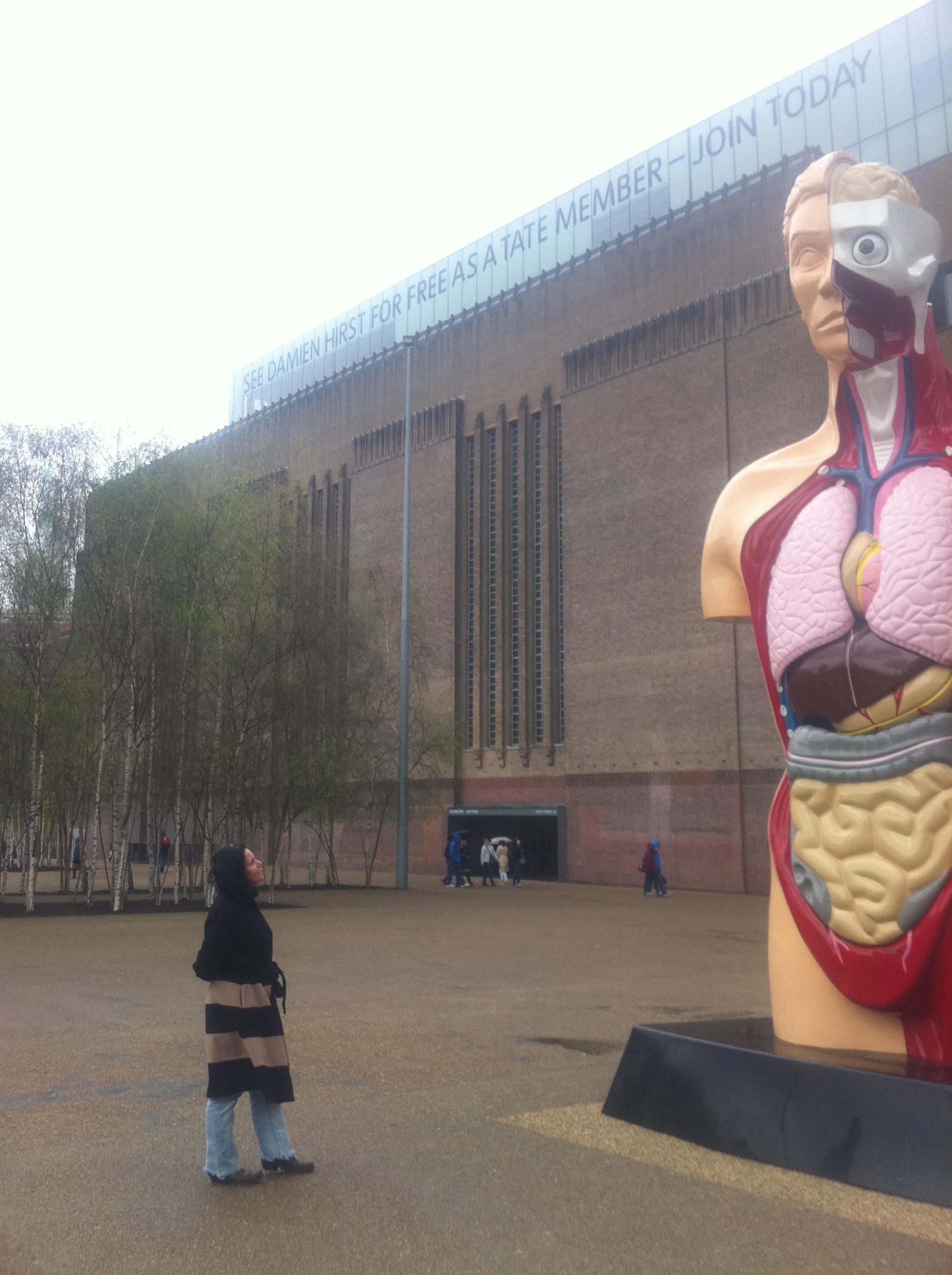
Hirst Impressions

Herself and Himself – me in conversation with Damien Hirst’s work, outside the Tate Modern, Southbank, London, April 2012. – Photo Amelia Nunes


Art begets art. A meeting between like-minded artists often results in a cross pollination of ideas which inspire, progress and crystallise art projects. Such an exchange can be an intended collaboration, or it can be an ego driven ‘anything-you-can-do-I-can-do-better’ brandishing. And it hardly matters which,  so long as art ultimately benefits.

Likewise, great inspiration can be found in complementary art forms. A poet can conjure new ideas from a dance; a musician can be moved to compose by a script. I a primarily a writer of prose fiction but as an Art College alumna – when I’m looking for inspiration, I go to an art gallery.

I went with a housemate on a field trip to London last week to see the Damien Hirst retrospective at the Tate Modern, the Picasso at the Tate Britain and the Freud at the National Portrait Gallery. All three were fruitful visits but, it was Hirst that had me stunned and flushed with ideas.

I’d seen Hirst’s ‘Shark’ before and was struck then by the concept that the creature did not know he was dead. The retrospective examines death in more detail. Death, an inevitable aspect of life, is not morbid in Hirst’s world, however. Rather it is presented as a beautiful  climax (Diamond Skull). Dead butterflies are arranged in stunning giant mosaics reminiscent of great stained glass windows. Even a grand wall-size black circular ‘sun’, composed of a million dead flies has all the elegance and plush luxury of a carpet fit for the feet of kings. Life/death – this complementary nature of opposites runs throughout the artist’s work. The mundane, even ugly are elevated to beautiful objets d’art. A classically sculpted marble angel reveals insides weird and devilish. A dead, fly infested cow’s head celebrates life cycles. Hirst’s work tells us that opposites need each other to exist. Opposites are each other. Rock it, Damien.


Naked truth

Self portrai in oil pastel, self-portrait in mirror.


Writing from truth, using a real event, can lend work real emotion, emotion difficult to conjure otherwise. Tears in a writer will bring tears to a reader, so they say. And as an artist, it is often your job to stand naked in front of the world.


Writing from fact does have its downside, however. Firstly, a straight account is reportage, not fiction so you must add extra spice and colour to the mixture to make it fiction, and interesting.


It is important to get to the naked crux of what your story is ‘saying’ and make sure your narrative never loses sight of this point and – so, even if when you were all driving to the hospital, Brad told a joke so funny you’ve just got to mention it. No, don’t mention it. Stick to the point of the story – the story is the hospital, remember, not Brad’s unrelated joke.


You may also have to leave out years of backstory if it does not serve to drive your own story on in any way. You may have been brought up by the funniest, most eccentric, most loving or most dysfunctional family in the world, but if they have no role in the story at hand, don’t mention them.


Another issue with writing from real memory is that ironically, fact is often too weird and too unbelievable to work as fiction. Your readers will say, ‘oh, come on, that would never happen.’ And you can’t phone them all up and say, ‘actually, it did. I’m not making it up. I once knew this bloke…’ Instead, you’ve often got to tone down the story to make it more credible. Real-life coincidences can be particularly problematic here.


And remember if you stick too close to the truth, you may be setting yourself up for some legal headaches, especially if you are presenting another person in an unflattering light. It’s best to change names and/or genders, and settings. Once you make those factual changes, most people will fail to recognize themselves in fiction, simply because we don’t see ourselves as we are seen by others….


Through the Looking Glass

There are writers feel story and character ideas are fed to them from “somewhere else”, a parallel universe perhaps, where these characters and stories truly exist.


Image

My no. 1 flat in Budapest – photo Nannette Vinson

Clearly, that “somewhere else” is a very vague concept and means different things to different scribes. Nonetheless, writers who hold such beliefs say it is very important to allow your mind to be open to receiving these ideas – wherever they come from.

Personally, I’ve had moments when I felt plugged into a conduit, receiving stories, characters and ideas- though I hesitate to say if this was a spiritual event or just the  way the brain works in creative mode.

And it is a rare enough event – I can never conjure ‘the writing rapture’ but if I write often it’ll roll around every now and again. And when it does, it’s a  magical moment when stories and characters come swimming to me, all done-up, pre-packaged and ready to go.

All we can do is sit down to write every day- most days you’ll get coal but if you keep at it, the diamond muse will show up sooner or later.


Reel me in!!!!

pick me, pick me, pick me! - Shortlisted for the Fish, 2012

Yay, first shortlisting of 2012! I’ve made the Fish Publishing shortlist. No mean feat from around 1,900 entries,  admittedly however, the shortlist is rather a long one with 145 stories to make it thus far (the long list was 550 apparently). David Mitchell is now judging and the winners will be announced on St. Patrick’s Day (March 17th to the un-Irish amongst you). Oooo I do like a good win…


WhywhyWHYwhyWhy?

Why this picture? Whywhywhy?

A fellow graduate of my MA in Creative Writing recently asked why I continued to write short stories, if I see myself as a ‘novelist’. The truth is I don’t see myself as a ‘novelist’ or a ‘short story writer’, ‘playwright’ or a ‘poet’. I see myself as a writer and believe that a writer should be able to (at least) try all written forms.

Truth be known, I write and enter short story competitions for the following reasons and it is good for me to have this list at hand – in case I ever question myself.

a) Being shortlisted encourages and motivates – when such stuff is difficult to come by in the writer’s life.

b) I can get published in literary magazines.

c) Money, if I win.

d) It keeps me on my toes and hones and polishes my craft.

e) By writing stories I build up a portfolio – ready to go in case I’m ever offered a collection.

f) It gives me an edge when applying for bursaries, residencies, funding etc..

g) It might bring  the attention of publishers.

h) Short stories are something I can work on when time is limited.

i) An agent once told me that it is important to build up your writing ‘credits’.

j) Agents are human and sometimes don’t trust their own judgement, so wins and commendations give you that ‘seal of approval’/credibility.

k) Short story writing is a better displacement activity than making a cup of tea.

M) Having good writing credits help when applying for writing jobs.

p) Writing short stories reminds me that I’m a writer.


Newspapers: more than fish n’ chip wrapping

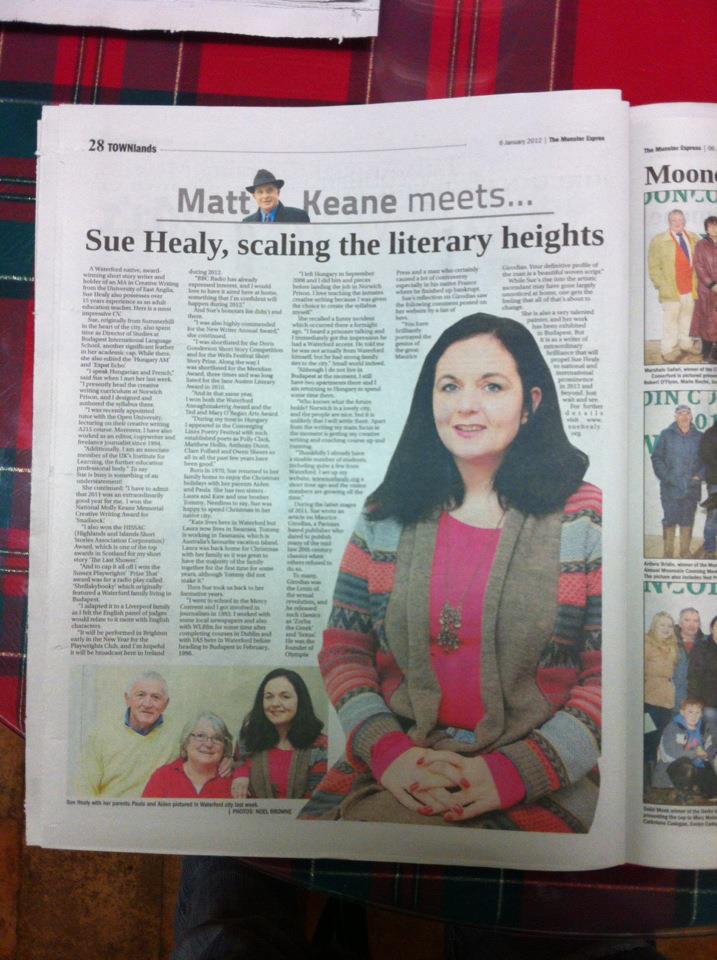
Yup, that's me. Sorry, couldn't resist the 'boast post' - the 'Munster Express, Jan 6th, 2012.

It’s January 14th, I’ve already completed a house move (and all the cleaning, paperwork and furniture selling/dumping that entails), I’ve spent a week in Budapest and prepped for a week of OFSTED inspections. I  hope 2012 will slow it’s pace soon so I can get some headspace and start thinking again. I’ll need conjure la muse… and get some inspiration for new works.

Leonardo di Vinci used to stare at the walls in his studio until the damp patches formed scenes and figures he wanted to paint. If you look closely at some of his works, you can even see how those dark stains suggested the rock formations he conjured. Of course, you don’t so much ‘get’ ideas as you eek them out from within.

Hopefully, you don’t have damp patches around your writer’s garret. You may have yesterday’s newspaper, however. I worked as a journalist for many years and love newspapers and appreciate them as a source of ideas and stories for the creative writer. For starters, you could just take an existing story and change the setting/gender etc… to make it your own. Ideas will come to you as you work on it.

Alternatively, you could apply the ‘what if’ question. The ‘what if’ question prompts you to consider alternative endings. A good example of this question is Stephen Fry’s Making History, in which he explores a world where Hitler was killed in WWI but an even more dastardly figure comes to prominence, and wins.

The small ads section can spur the imagination. Hemmingway once said his best work was one he wrote in six words: “For sale: baby shoes, never worn”. It’s clever as there is clearly a heavy back story here but Hemmingway, being Papa, does not spell it out. My point is that you could operate in reverse, search the small ads and then write its back story. Think of the tale behind a novel that ends with that small ad.

Then there are photos. Ignore the captions/related stories. Look at the photos and guess what is going on. Develop an identity for someone in the background of a picture. Give them a problem. Imagine how they are being affected by the main event in the photo. The key is to go for the more obscure shots. Obviously, if it’s a picture of 9/11, the chances are you’re not going to come up with anything too original but if it’s a picture of a man biting a dog, you may be on to something.

Go hunting, Newshound!


Welcome 2012 And Resolution Writing Course

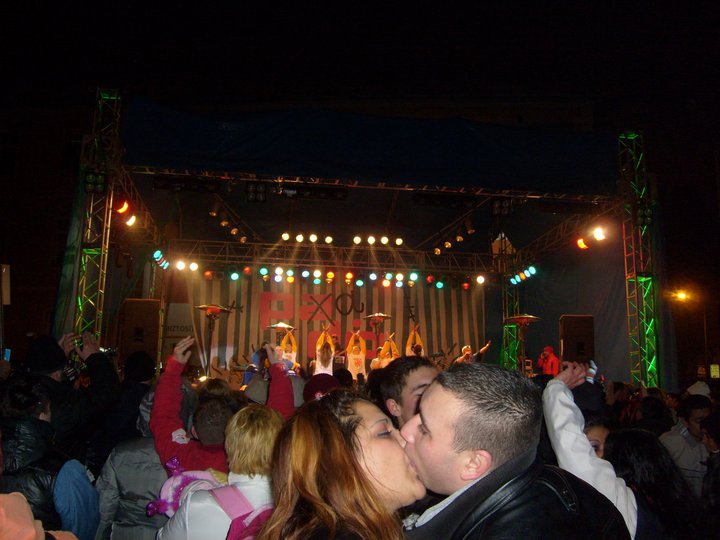
Revellers bring in the New Year, Hungarian style

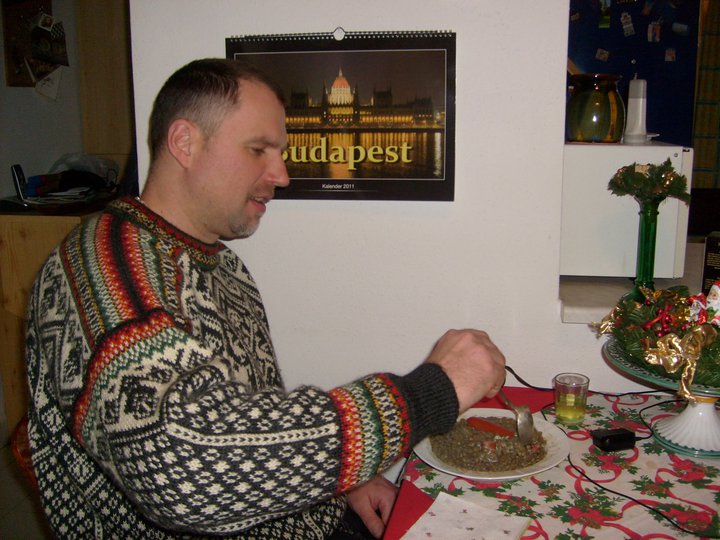
Here in Budapest, tradition states one must eat a bowl of lentil soup on New Year’s Eve/Day to attract luck and fortune in the year to come. Last year, my friend Joska invited me to lunch on Jan 1st. He’d cooked a barrel load of the stuff and it was so cold outside we rather overdosed on the bean. Lo and behold, 2011 turned out to be a year of great fortune re my writing. I won three awards, was shortlisted for even more, had quite a few shorts published. Moreover, I set up this website and my online writing course – both of which I’m enjoying immensely and I’ve resolved to make the course my focus for the coming year.

My course, ‘Creative Writing: A Toolbox’ is a six week online one-on-one creative writing introduction. With it, I aim to help you realize your dreams of writing creatively, or improve the practice of those already writing. The course regards the tools of the craft and provides online support for your work via feedback and guidance in relation to editing, submission and markets. Each course is adapted to suit the individual needs of the specific student. There is also the option of retaining my services as a mentor/critic/coach after the course ends.

Creative Writing: A Toolbox’ is supported by written material, exercise, assignments and a weekly 45 minute one-on-one online tutorial to guide the student through the six step, six week writing course. This tutorial is usually given via Skype, though some students prefer to use email alone – that is for the student to decide.  Over the six sessions, the student is introduced to the know-how, ‘tricks’ and skills of the writer and can work on their own project, such as a short story or part of a novel – whilst, receiving online coaching, instruction, feedback and guidance from Sue.

Throughout the course,  students will receive a full professional critique of their work from Sue.

All inclusive price: €150 (introductory offer)

For more information, please contact me on : bpapartment at gmail dot com

In the meantime, if you’d like to make your own Hungarian lentil soup check here: http://allrecipes.com/recipe/lentil-soup-2/

Joska eating lentil soup on New Year's Day

Wishing you all the best for 2012 – may your ships come in with your dreams onboard.

Sue xo