Tag Archives: writing

Suprising First Lining

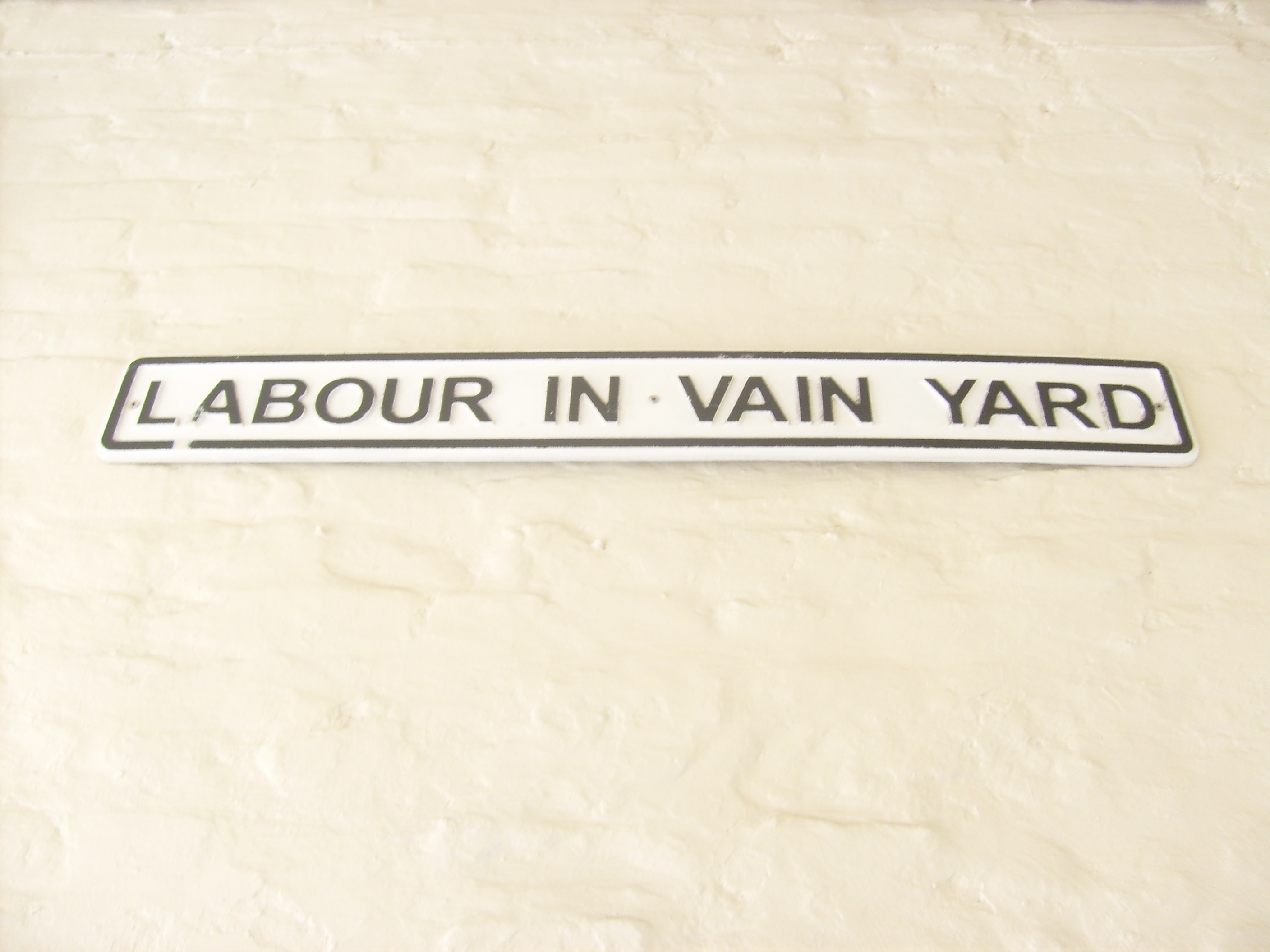
Name of a ‘yard’ in Norwich. The capital of East Anglia has the most surprising monikers for streets, including: ‘Tombland’, ‘Queen of Hungary Yard’, Rampant Horse Street’ and Unthank road. All would sit well in amazing first lines….

Your first line is probably the most important in your work. It should surprise and intrigue your reader and somehow give a taste of what is to come. Ideally, it should be unusual or uncanny and most importantly, it should encourage your reader to read on…

‘”Damn,” said the Duchess.” is a first line attributed to Agatha Christie. “Damn” was a pretty raw word in 1920 or so, rarely uttered in front of ladies, not to mind say by one, and then one of high social standing. So, an opening line such as this was written to shock, to intrigue, to grab the readers’ attention and it is a good idea to find one with a similar punch in the modern age.

Thereafter, follow your first line with a pacy set of three chapters. These are also the showpiece you’ll be sending off to agents and publishers, so make sure they’re written to hook.

Some writers write their last chapter first, so they can figure out their plot, and then leave writing those all-important first few pages until last. In fact, the very last piece of writing they might do is the first line. Therefore, don’t fret over your opening, get the rest of your work down and come back to it later if necessary.

And, take note that just as your first line should reach out and grab your reader – your final line should linger with your reader for sometime afterwards…


Can you guess which works gave us the following opening lines? Answers below


1) ‘It is a truth universally acknowledged, that a single man in possession of a good fortune, must be in want of a wife.’


2) ‘I’m writing this sitting in the kitchen sink.’


3) ‘It was the best of times, it was the worst of times.’


4)It was a bright cold day in April, and the clocks were striking thirteen.’


5) ‘If you really want to hear about it, the first thing you’ll probably want to know is where I was born, and what my lousy childhood was like, and how my parents were occupied and all before they had me, and all that David Copperfield kind of crap, but I don’t feel like going into it, if you want to know the truth.’

6) ‘Stately, plump Buck Mulligan came from the stairhead, bearing a bowl of lather on which a mirror and a razor lay crossed.’


7) ‘Mother died today.’


8 ) ‘It was the day my grandmother exploded.’


9) ‘The past is a foreign country; they do things differently there.’


10) ‘He – for there could be no doubt of his sex, though the fashion of the time did something to disguise it – was in the act of slicing at the head of a Moor which swung from the rafters.’

 __________________________________________________________

1)      Pride and Prejudice, Jane Austen.

2)      I Capture the Castle, Dodie Smith

3)      A Tale of Two Cities, Charles Dickens

4)      1984, George Orwell

5)      Catcher in the Rye, J.D. Salinger

6)      Ulysses, James Joyce

7)      The Stranger, Albert Camus

8 )      The Crow Road, Iain Banks

9)      The Go-Between, L.P. Hartley

10)   Orlando, Virginia Woolf


Let the Show Flow

Showing or Telling? Post box, Norwich, England


Telling: “Close the door,” she said nervously.

Showing: Her cigarette trembled in her hand: “Close the door.”

Telling: Peter was a fussy, neat sort of man.

Showing: Every Monday, Peter ironed and folded his towels into perfect squares and stacked them in the airing press, according to size and colour.

“Showing” your reader what your protagonist is thinking/doing, encourages your reader to engage more with your book/story/play, to interpret and picture what is going on. Showing also allows for more atmosphere and lends insight into character. Conversely, “telling” tends to deliver all the information neatly wrapped and can deny the reader all the fun of involvement and imagining. Therefore, rather than telling the reader, ‘Bob was depressed,’ you might describe what Bob was doing and saying and the reader will also get a greater sense of ‘Bob’ if you do so.

Having said that, if the writer “shows” every inch of their novel it may bore the reader and slow the pace. There are times, for the sake of speed and economy, the writer needs to “tell”, so they can quickly move on to the next stage of the story.

If I could suggest a rule of thumb, it would be “show” the most important parts/events of the story and “tell” the minor linking passages. It’s your judgement call as to when and where to show or tell, but do give it thought. Finally, please bear in mind the general consensus is that you always avoid telling via adverbs in speech attribution: “he said arrogantly”, “she shouted defiantly”, “we mumbled apologetically”. Instead, try to think of ways you could show this arrogance, defiance or apology.


Quite a Character

Name her. Now answer the questions below about her.

If you want to hook your readers, you’ll need a character that leaps off the page. A good character is believable and interesting. Firstly, be careful your character is not of music-hall-cliche stock (dumb blonde, greedy banker, uber-organized German, upper class twit etc…) – the problem here is that the reader will have met your character far too many times before to find them interesting now. As usual, turning the cliche on its head can be a good place to start getting ideas (chess-master page three girl, a banker who secretly gives away money etc…)

Also, don’t focus on describing what they look like from head to toe. In fact, their general physical appearance is not so revealing – the key is often in the interesting quirks and blemishes. Moreover, you ought to climb inside your character’s skin, get to know them intimately and let the reader see how they tick. It  is  good if there is something unusual about them. Here’s a sample list of questions you could mull in order to give your character depth:

Rather than describe the colour of their hair and eyes, write instead about their height.

What about their gait, posture and walk? Does he flutter, jerk, flap or glide?

If you first met this character, what would strike you most?

Does s/he resemble an animal?

What is their natural scent?

What sort of diet do they have and what has been the physical impact of this regime?

What does their best friend think of them?

What happens when your character gets drunk?

What does your character have in his/her pockets/handbag/beside table?

What is your character’s favourite joke?

Also, to make your character particularly memorable, give him/her/it a singular physical attribute your reader will long associate with them. Think of it this way, if you were going to a costume party dressed as Harry Potter, Sherlock Holmes, Miss Havisham or Liesbeth Salander – what would you need? My guesses are, respectively: a lightening bolt scar, a deerhunter hat and pipe, an old wedding dress, and a dragon tattoo. Try to imagine what you’d need to be recognizable as your character.


Hirst Impressions

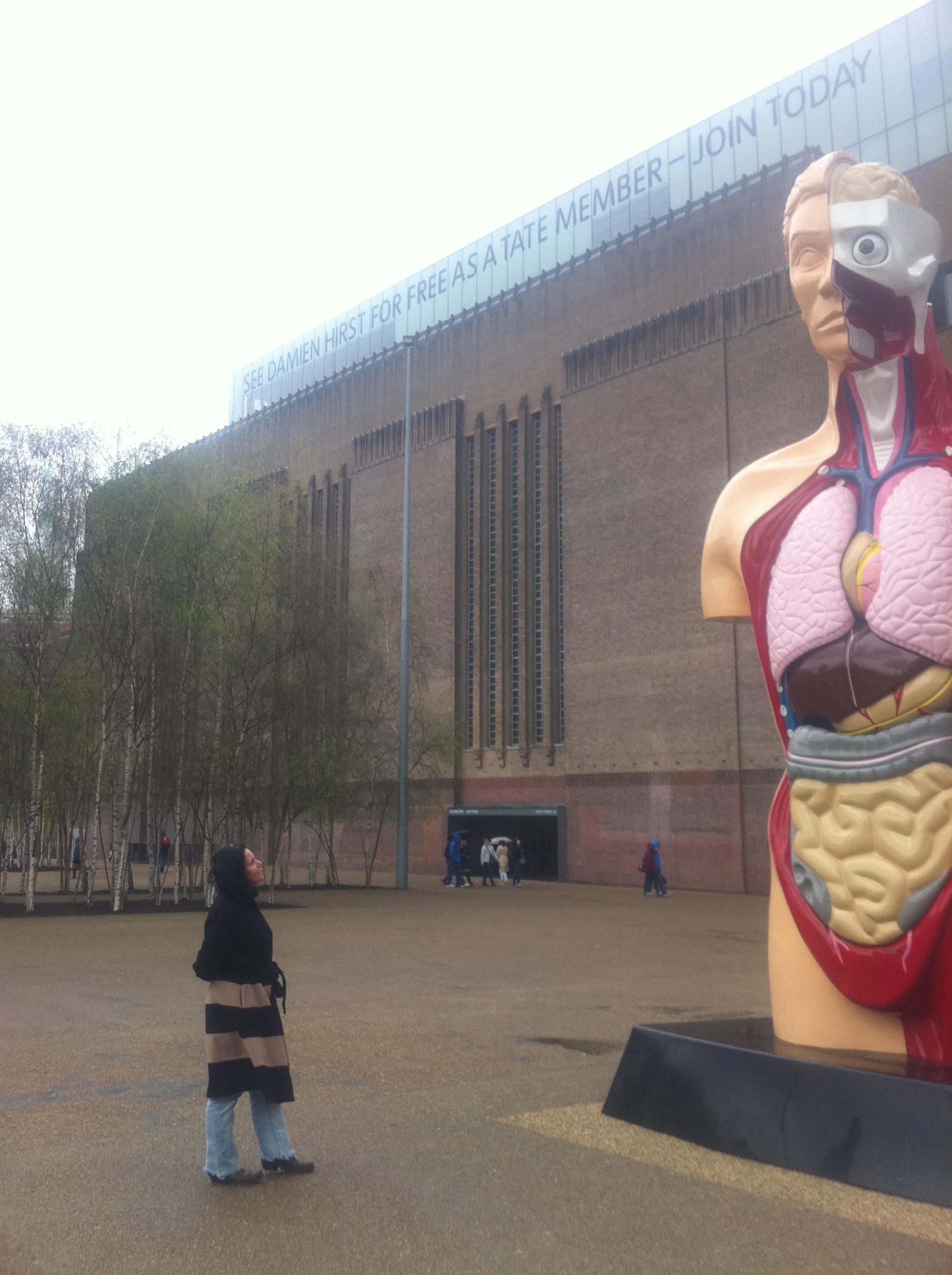
Herself and Himself – me in conversation with Damien Hirst’s work, outside the Tate Modern, Southbank, London, April 2012. – Photo Amelia Nunes


Art begets art. A meeting between like-minded artists often results in a cross pollination of ideas which inspire, progress and crystallise art projects. Such an exchange can be an intended collaboration, or it can be an ego driven ‘anything-you-can-do-I-can-do-better’ brandishing. And it hardly matters which,  so long as art ultimately benefits.

Likewise, great inspiration can be found in complementary art forms. A poet can conjure new ideas from a dance; a musician can be moved to compose by a script. I a primarily a writer of prose fiction but as an Art College alumna – when I’m looking for inspiration, I go to an art gallery.

I went with a housemate on a field trip to London last week to see the Damien Hirst retrospective at the Tate Modern, the Picasso at the Tate Britain and the Freud at the National Portrait Gallery. All three were fruitful visits but, it was Hirst that had me stunned and flushed with ideas.

I’d seen Hirst’s ‘Shark’ before and was struck then by the concept that the creature did not know he was dead. The retrospective examines death in more detail. Death, an inevitable aspect of life, is not morbid in Hirst’s world, however. Rather it is presented as a beautiful  climax (Diamond Skull). Dead butterflies are arranged in stunning giant mosaics reminiscent of great stained glass windows. Even a grand wall-size black circular ‘sun’, composed of a million dead flies has all the elegance and plush luxury of a carpet fit for the feet of kings. Life/death – this complementary nature of opposites runs throughout the artist’s work. The mundane, even ugly are elevated to beautiful objets d’art. A classically sculpted marble angel reveals insides weird and devilish. A dead, fly infested cow’s head celebrates life cycles. Hirst’s work tells us that opposites need each other to exist. Opposites are each other. Rock it, Damien.


I’ve been haiku’d!

A haiku for a weeping willow in Norwich?


If you need focus, get haiku’d. The Japanese know how to appreciate the moment: tea ceremonies where the design and the feel of the cup is lauded, the colour of the drink discussed, the scent, the very feel of the beverage dissected and praised.

Not surprising, therefore, the land of the rising sun gave us the haiku. Haiku is a poetic form that, traditionally, aims to capture a moment in nature, like a snapshot with words.

Most typically achieved using seventeen syllables arranged in three unrhymed lines of five, seven and five syllables, the practice of writing haikus is particularly useful if you are engaged in a word-limited literary arena such as writing songs. In such instances, words should be chosen carefully so that they can convey the specific mood, meaning and impact you require and haikus can help you build up that muscle. Haikus encourage you to pick up every word and study it closely for its sound, meaning, feel and impact.

Here are some examples of the haiku:

O’er the wintry wood,

winds howl in an empty rage

with no leaves to blow.

Soseki (1275-1351)

This haiku by the ‘punk poet, John Cooper Clarke, comes via recommendation of Westown Girl :

Writing a poem

In seventeen syllables

Is very diffic.

(John Cooper Clarke, 1979)

Cool, innit?

Happy Haikuing


The Temptations of Tea…

Image


Sit at computer, bring up blank page, make a cup of tea. Sit at computer, look at blank page, do the washing up. Duration: 1 hour. Word count: 0

If this sounds like your typical writing pattern, you’ve got plenty of company. The sudden urge to do housework, rearrange books, check your bank statement- when you really ought to be writing is known as ‘Displacement activity’.


Displacement activity is the bane of a writer’s life. It’s the phrase writers have for all the stuff you do that is not the stuff you are SUPPOSED to be doing. Avoidance is probably a more readily understood term, but doesn’t sound half as writerly. What happens is a little ‘displacement monkey’ in your mind distracts you from the task at hand, by urging you to ‘make another cup of tea/check the TV guide/your bank account/ebay/post on this blog : ) rather than crack on with that difficult piece of dialogue you’re trying to get down.


I don’t believe displacement activities are wholly bad. I feel they sometimes happen for a reason. Perhaps what you’re working on needs time to settle, or percolate in your mind and after you’ve bought those gloves on ebay, it will all come together. However, I admit, I think I’d get a lot more writing done if I didn’t have an Internet connection in my office… I know a few writers who keep their displacement activity on hand – as another creative hobby such as painting, and they believe one such activity complements and feeds the other. So, they may start painting and then half way through THAT activity they’ll turn back to their writing as a displacement activity for their painting and so on…


As with everything in writing, if you find your displacement activity works for you, then go knock yourself out with it. If it is a hindrance, then find a way to stop it distracting you such as getting a room with no internet connection…


You Don’t Have to be Irish…

A picture from Ireland - Lismore Castle, Co Waterford. My grandmother's hometown.

You don’t have to be Irish to be a great writer, but it helps. An oft debated point is the essential ingredient that has given the Irish the edge re the written word ever since the Book of Kells. There are many takes on the matter. Some say it’s because although most Irish writers write in English, they use the syntax, structure and playfulness of the Irish language which gives a mastery and an unusual manner of wielding English that results in, well, pure poetry. Others suggest it is our tradition of story telling, living on in sizzling and stinging pub banter. Some put it down to our sad history, allowing for a depth and pain to infuse our written word. However, I’m with the crowd that says its simply because we’re a race of freaking geniuses. Happy St. Patrick’s Day! Go mbeirimid beo ar an am seo arís…

Famous Irish writers: Sebastian Barry, Samuel Beckett, Elizabeth Bowen, John Banville, Brendan Behan, Dion Boucicault, Roddy Doyle, Emma Donoghue, Maria Edgeworth, Brian Friel, Oliver Goldsmith, Neil Jordan, John B. Keane, Colum McCann, John McGahern, Iris Murdoch, C.S. Lewis, Edna O’Brien, Jennifer Johnston, James Joyce, Patrick Kavanagh, Molly Keane, Hugh Leonard, Martin McDonagh, Frank McGuinness, Sean O’Casey, Joseph O’Connor, George Bernard Shaw, John Millington Synge, Colm Toibin, Oscar Wilde, WB Yates, Bram Stoker, Jonathan Swift… to name but a few.


Naked truth

Self portrai in oil pastel, self-portrait in mirror.


Writing from truth, using a real event, can lend work real emotion, emotion difficult to conjure otherwise. Tears in a writer will bring tears to a reader, so they say. And as an artist, it is often your job to stand naked in front of the world.


Writing from fact does have its downside, however. Firstly, a straight account is reportage, not fiction so you must add extra spice and colour to the mixture to make it fiction, and interesting.


It is important to get to the naked crux of what your story is ‘saying’ and make sure your narrative never loses sight of this point and – so, even if when you were all driving to the hospital, Brad told a joke so funny you’ve just got to mention it. No, don’t mention it. Stick to the point of the story – the story is the hospital, remember, not Brad’s unrelated joke.


You may also have to leave out years of backstory if it does not serve to drive your own story on in any way. You may have been brought up by the funniest, most eccentric, most loving or most dysfunctional family in the world, but if they have no role in the story at hand, don’t mention them.


Another issue with writing from real memory is that ironically, fact is often too weird and too unbelievable to work as fiction. Your readers will say, ‘oh, come on, that would never happen.’ And you can’t phone them all up and say, ‘actually, it did. I’m not making it up. I once knew this bloke…’ Instead, you’ve often got to tone down the story to make it more credible. Real-life coincidences can be particularly problematic here.


And remember if you stick too close to the truth, you may be setting yourself up for some legal headaches, especially if you are presenting another person in an unflattering light. It’s best to change names and/or genders, and settings. Once you make those factual changes, most people will fail to recognize themselves in fiction, simply because we don’t see ourselves as we are seen by others….


Through the Looking Glass

There are writers feel story and character ideas are fed to them from “somewhere else”, a parallel universe perhaps, where these characters and stories truly exist.


Image

My no. 1 flat in Budapest – photo Nannette Vinson

Clearly, that “somewhere else” is a very vague concept and means different things to different scribes. Nonetheless, writers who hold such beliefs say it is very important to allow your mind to be open to receiving these ideas – wherever they come from.

Personally, I’ve had moments when I felt plugged into a conduit, receiving stories, characters and ideas- though I hesitate to say if this was a spiritual event or just the  way the brain works in creative mode.

And it is a rare enough event – I can never conjure ‘the writing rapture’ but if I write often it’ll roll around every now and again. And when it does, it’s a  magical moment when stories and characters come swimming to me, all done-up, pre-packaged and ready to go.

All we can do is sit down to write every day- most days you’ll get coal but if you keep at it, the diamond muse will show up sooner or later.


Reel me in!!!!

pick me, pick me, pick me! - Shortlisted for the Fish, 2012

Yay, first shortlisting of 2012! I’ve made the Fish Publishing shortlist. No mean feat from around 1,900 entries,  admittedly however, the shortlist is rather a long one with 145 stories to make it thus far (the long list was 550 apparently). David Mitchell is now judging and the winners will be announced on St. Patrick’s Day (March 17th to the un-Irish amongst you). Oooo I do like a good win…