Category Archives: Writing

You On Your Rocking Chair, Me On My Bench

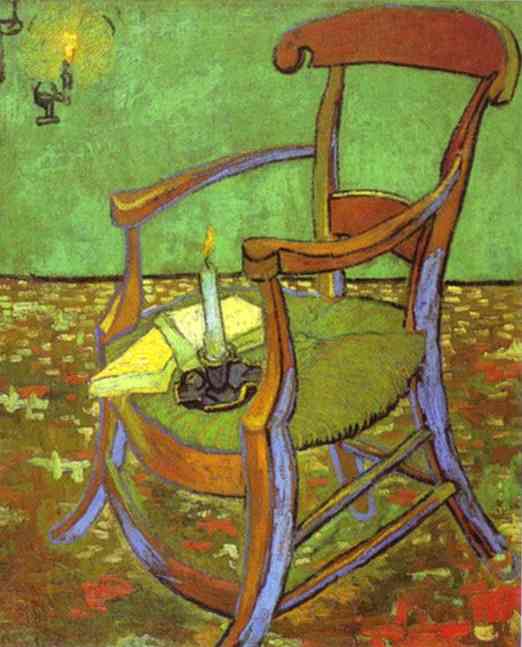
Van Gogh’s Portrait of Gauguin’s Chair

Setting and character description are linked. A man who favours a torn leather armchair filled with cushions is  quite different from a man who rathers sleek minimalist designer furniture. The setting should complement and reflect the character.

It is often effective to draw around the character, sketch them in their absence. What type of chair do they favour? Wallpaper? House? What book is left on their bedside table? Is their office desk obsessively orderly or natty and neat?

I have a background in fine art painting and I find painting is a great way to understand this aspect of character description – the concept of describing your characters by drawing around them rather than delivering a direct portrait of the same. I like to compare these two portraits by Vincent Van Gogh: one a self portrait and the other Van Gogh’s portrait of Paul Gauguin.

What do you think Vincent is communicating regarding his own and Gauguin’s character and personality?

(Bear in mind that Van Gogh and Gauguin were close once but their relationship became strained when they house-shared at Arles – when these portraits were painted.)

And how would you paint these two portraits in words?

Van Gogh’s Chair, Self Portrait


Oh Happy Daze

Oh happy days. I’m in Budapest for the season with my dearest, most supportive, most loyal friends – in many ways, my family.  And I’ve reason to celebrate. A radio drama I wrote and am producing ‘Cow’,  has won full funding  from the BAI  Sound and Vision  scheme. We will go into the studio, in Kilkenny, Ireland, the first week in February.

The drama is to be directed by renowned Irish director/playwright Jim Nolan. ‘Cow’ will also feature the talents of Waterford actor Michael Power, who recently finished shooting an episode of ‘Game of Thrones’ for HBO, Madeleine Brolly, a veteran of BBC Radio 4 drama and Geraldine Crowley, a Dublin based actor who hails from Barrabehy, Co. Kilkenny. The soundscape will be managed and produced by BBC sound engineer, Eugene Sully. They’re a highly professional and talented team, I’m enormously lucky to have them on board and I’m sure their expertise will enhance my little drama no end.

Catching up with dear friends, Dob utca, 22nd Dec. 2012

And on the same day I got word that ‘Cow’ was successful in the funding bid, I also heard that I’ve been shortlisted for the East of England’s Escalator Award – on a proposal for a novel I’m writing. So, once again, Oh happy days!

Hey, this year has been challenging in many other ways. There have certainly been tough moments. But how lovely to go out on such an up beat note. And, I’m due to enter the New Year with an intense, focused period of writing on Inis Oirr, one of the Aran Islands, where I’m ‘artist-in-residence’ for January.

I’ve got a long list of projects to concentrate on whilst there, and am hoping it proves very fruitful – if I don’t get blown off a cliff. The population is Irish speaking – which will be a challenge, as I haven’t really  spoken Irish since I left school. Ufasach!  If you’ve ever seen ‘Father Ted’, Inis Oirr is actually the island used as ‘Craggy Island’, in the opening credits. Yes, I’ll probably turn up in the Kilkenny studio with a full beard and a grizzly bear in tow. But hey, it’ll be worth it.

Many thanks to you, visitors to my blog, for dropping by this year. I wish you all the best of the season and may you have much success in all your endeavours in 2013!

,,,


Home

Budapest in December

Budapest in December

There are a few schools of thought on where a writer should live. In the 1920s and 1930s, the greats flocked to Paris, the 1960s – London, the 1990s – Prague, and perhaps it was Berlin in the noughites.

However, it should hardly matter where you are, if you are determined and disciplined, you’ll write in a suburban semi in a provincial town, just as well as you will in a garret in Montmartre. One thing the abovementioned cities do have in common is that they were all cheap places to live at the time of their popularity with writers. Writing is not a well paid profession, and it makes sense to nest somewhere where rent and food is affordable, thus lessening that worry every month. Other writers will argue that one should focus on areas where artists are congregating so one can better breathe in the zeitgeist, feed on that cross pollination of ideas. Then there are those who say it is a better idea to reside somewhere in relative proximity to the centre of your chosen industry – and for publishing that would be London/New York/Berlin. Others suggest pitching down in a city which is going through an ‘interesting time’ such as a war or social revolution.

Dunmore East, Co. Waterford, Ireland

Dunmore East, Co. Waterford, Ireland


I’ve come to my own conclusion which I’d like to share today. I’ve spent much of my life wandering (perhaps running away, or was that gathering experiences?) So much so, that it is hard to know where home is now and I’ve spent the past year considering my future quite strongly. I think it is time I surrendered and called somewhere home and I think I’ve found the spot or rather, it has found me.

This Christmas/New Year, I’m spending time in Norwich, UK, Budapest, Hungary and Waterford, Ireland. All of which could lay a claim to being my home – and in some respects, they all are yet none of them are.

Having spent the majority of my adult life abroad, the impact of my experience of exile is thrown in to relief when I return to Ireland. And I don’t like that sense of no longer belonging. Also, Ireland is as complicated, contrary, passionate, stroppy, defensive and temperamental as I am. And therefore, I am not convinced it is the place to live as a writer (although, it does make for excellent material).

Budapest, my adopted home, the city which gave me maturity and launched me as a creative writer – and where the majority of my friends and social circle still reside, is slipping from me. A friend emailed yesterday with some suggestion of cafes I should try out when I’m in Budapest over Christmas. I was mildly affronted. I don’t need ‘where-to-go’ tips for a city I lived in for eleven years. I used to edit a guide to Budapest, forcryingoutloud! But in truth, I didn’t know any of the places my friend suggested. Life has moved on in Budapest, without me. I’m am no long of that beautiful city. Also, Hungary has recently taken some scary steps politically and I don’t want to be there while it continues on that sad path – though I do feel compelled to comment on it from afar.
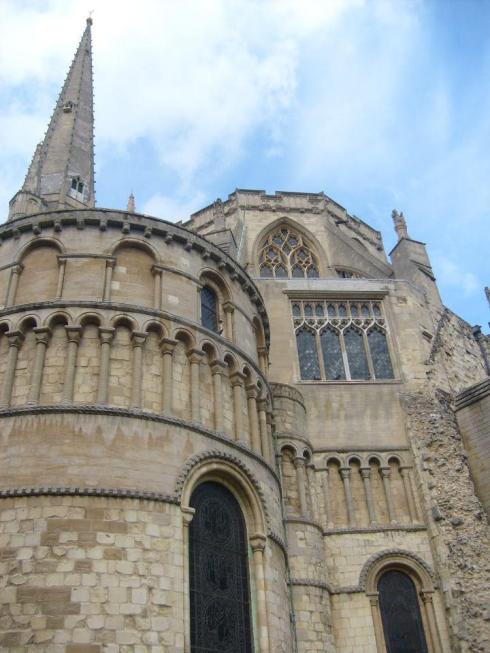
Norwich, a 'fine' city.

Norwich, a ‘fine’ city.


And then there’s Norwich, England, a city where I came to study for my MA in Creative Writing and have ended up spending much time here over the past four years. Norwich is a pleasant, very English city, which I had to locate on a map the week before I arrived here. All I knew about Norfolk was that Oliver Cromwell came from hereabouts, which to an Irish person, is not a great recommendation.

I’ve since found Norwich to be a ‘goldilocks’ town. It’s not too much of anything, yet it seems to have everything in moderate measure. In short, it is comfortable and pleasant and undemanding and reserved and allows me to sit back and digest the years I spent living in more dramatic, demanding, raw, aggressive, passionate theatres like Hungary and Ireland. In this way, I feel that Norwich is, in its quiet, unassuming way, a city conducive to art – if more so as a catalyst in its facilitation of creativity, rather than a city that inspires great art per se.

Can I dare to say that I’ve found home? I don’t think I’ve quite made that decision yet – but I can venture that it is quite likely that Norwich will be my home in the future.

Unruly Herman

rulz

I was recently given a ‘Herman the German’ chain cake recipe – a German sour dough friendship cake which has a gestation period of ten days after which you add to the mix, divide into four, bake one and give the remaining three goo mixtures away to friends, who do the same and so on and so on.

There were no measurements in the instruction list, simply ‘add egg, add flour’ etc… This is my kind of recipe. I don’t like being dictated to. I like to experiment and break rules when I come across them, to see what happens. I think this is a healthy trait in a writer. However, for the unpractised/unpublished writer – it is important to know the rules first…

Currently (and yes it is subject to fashion and trend) the big ‘no no’ is cramming sentences with adjectives and adverbs. A new writer will often fall in love with words and phrases and become over-enthusiastic in their application. However, overly verbose writing deadens the impact of the sentence – which defeats its purpose. So, the rule is, use adjectives but go easy and be clear.

An example of an adjective/adverb heavy sentence:

‘A dark grey, crinkled brow of solemn cloud crept sluggishly over the majestic hills that were patchily bruised with a blackish purple moss and randomly spiked with prickly yellow furze.’

There is too much going on in this sentence. Each individual image is in competition for the readers’ attention. The result is a boring blur. Think about what is necessary here. Everyone knows furze is yellow and prickly, so do you need to inform the reader of these facts? “Majestic” doesn’t really do anything here – except communicate that the hill is big, which one would assume.

I would pare the sentence to the following: ‘A cloud slugged over the hills.’

I hope you can see how ‘less is more’ here. The image is much stronger without shoehorning in all those adjectives/adverbs.

A note on adverbs:

Adverbs have a bad reputation in the literary world. Many writers avoid them completely (there’s one right there). I would suggest you use them with caution and very, very sparingly (see, another one) and never, ever with speech attribution (“she said nervously”). Adverbs like “suddenly” or “immediately” are thought of as cliché traffic lights. If something happens unexpectedly in a story, you don’t need to “flag it” to make the reader aware that this was a “sudden” action – it should be obvious. So, don’t use them.

Over reliance on adjectives and adverbs is a typical, and some would say necessary, phase for those beginning their writing journey. So, don’t worry if you recognize your own writing here. As “mistakes” go, the over use of adjectives and adverbs is a useful one, as it serves to build your vocabulary. All good writers should have this phase. Just keep calm, carry on, edit down the adjectives and remove the adverbs – and you’re on your way.

Now, I’d best go check on my Herman cake…


Me Time

cropped-rtemagicc_sue-healy.jpg


I’ve got a younger colleague who is rather plugged in to all things techie and ITish – and thanks to his urging, I’m now not only twittering, but also looking at doing some links to pdfs of my stories and perhaps a kindle collection down the line (thanks again, Dan!). In the meantime, if any of you are interested, here are some stories of mine already published online.

The Last of the Shower – A quirky and nostalgic punk looks to wake his dead bandmate: HISSAC Highlands and Islands Short Story Association Competition has ‘The Last of the Shower” on their site (which won the2011 Award).

Grapefruit – An over-privileged youth is accused of a sexual misdemeanour. Winner of the Meridian Award.

Ha-Ha A blackly comic story, with a twist. A runner up in the Limnisa/Bluethumbnail Competition:

The Pretender – A tale with a twist and intrigue, which was ‘highly commended’ in the Twisted Stringybark competition. ‘The Pretender’ can be downloaded as part of an anthology:

Thanks for the interest!


Falling in Love

Lovers in Central Park


My newest short story, and theatre piece is a Romance, a love story which celebrates love. This is a bit of a departure for me. I’m feeling rather sheepish about it as I’ve always written about misfits and misanthropes, lame ducks and lushes, the crazed and the confused – set in bizarre situations, where there is rarely a happy ending, but everyone has a great time before they all die in the end. And no one every falls in love outside some sort of sexually confused stalking type thing…

But since August, I’ve written two love stories with, well, I’m not going to say ‘happy’ but certainly satisfying endings. My new stories are not, I hope, clichés and they deal with meaty issues (infertility, instinct etc…) So, I haven’t begun to wear pink chiffon or whatever. Still, they are love stories. So, what is happening to me?

I’m thinking it’s a sign of maturity at a writer. I avoided romance before as I felt the darker side was the deeper, the more intellectual and philosophical.

However, I’ve found that recently my writing has become more comfortable portraying real people in everyday events, which includes falling in love. And I’m enjoying exploring this soft, sensitive territory and I’m hoping I’m doing it justice. And I believe this is a sign of me progressing as a writer.

Now, if you’ll excuse me, I’ve got to go feed caviar to my poodle who’s just pee-d on my pink satin cushion.


Haiku! Bless you.

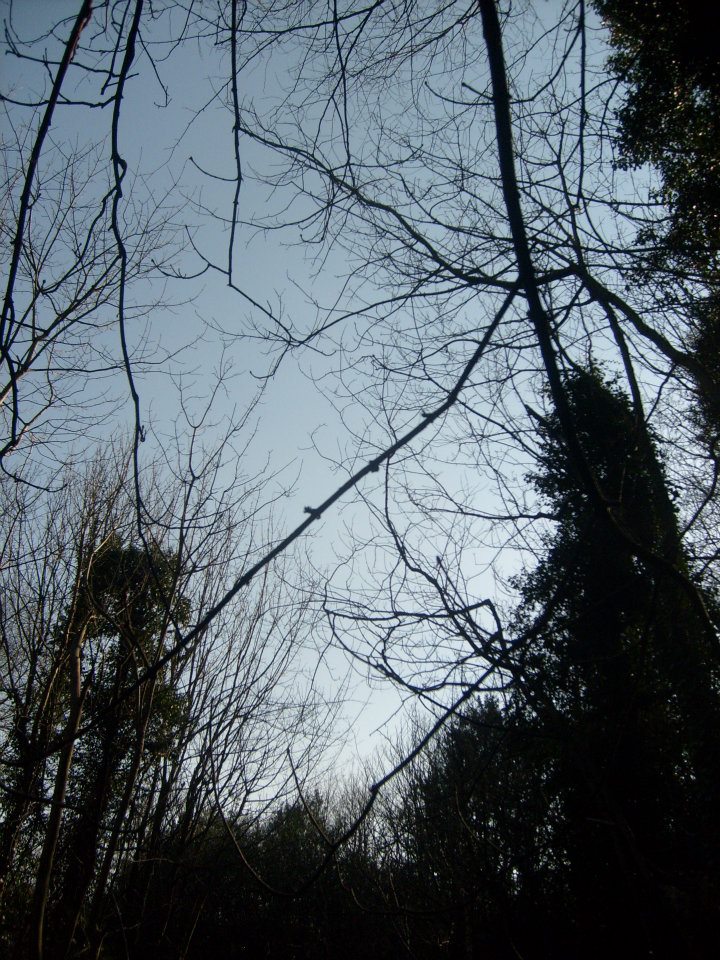
Wintry wood, Bracondale


If you need focus, get haiku’d. The Japanese know how to appreciate the moment: tea ceremonies where the design and the feel of the cup is lauded, the colour of the drink discussed, the scent, the very feel of the beverage dissected and praised.

Not surprising, therefore, the land of the rising sun gave us the haiku. Haiku is a poetic form that, traditionally, aims to capture a moment in nature, like a snapshot with words.

Most typically achieved using seventeen syllables arranged in three unrhymed lines of five, seven and five syllables, the practice of writing haikus is particularly useful if you are engaged in a word-limited literary arena such as writing songs. In such instances, words should be chosen carefully so that they can convey the specific mood, meaning and impact you require and haikus can help you build up that muscle. Haikus encourage you to pick up every word and study it closely for its sound, meaning, feel and impact.

Here are some examples of the haiku:

O’er the wintry wood,

winds howl in an empty rage

with no leaves to blow.

Soseki (1275-1351)

This haiku by the ‘punk poet, John Cooper Clarke, comes via recommendation of Westown Girl :

Writing a poem

In seventeen syllables

Is very diffic.

(John Cooper Clarke, 1979)

Cool, innit?


Word up

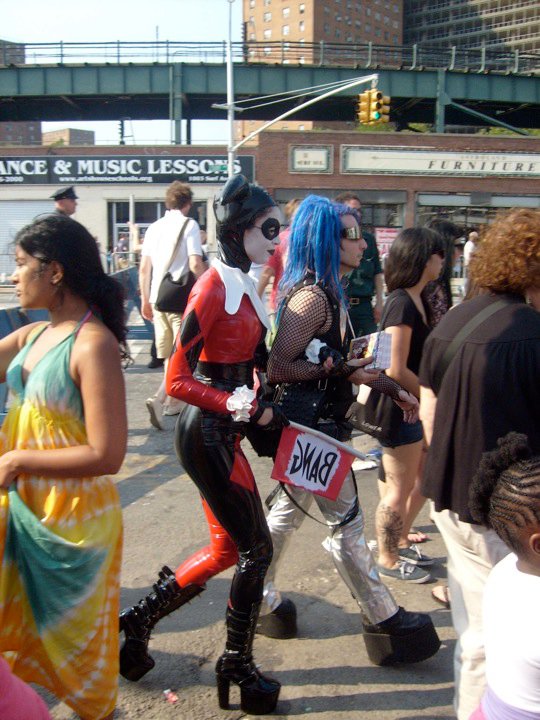
Bang!

As a linguist and a writer, I love words. However, as a teacher of creative writing, I know that the mis/over use of words, particularly adjectives and adverbs, is the most common ‘fault’ you’ll find in the work of novice writers.Insecurity will have new writers shoehorn as many descriptive words as they can get into a sentence – with the result akin to an over ‘bling-ed’ Christmas tree. The advanced writer will ‘show’ an emotion/atmosphere/interpretation without  resorting to a heavy-handed sprinkling of descriptive words.

It’s hard to ween yourself off adjectives and adverbs. Part of the problem is that there are so many words in the English language, a tongue with more word-families than any other language. This fact is rooted English having sprung from French and German, so there are English words that describe quite similarly (ie “loving” is from German and “amorous” is from French). And with such a lavish spread on offer, it is hard for the newbie writer to exercise restraint. Oh but, to improve, you must.

That is not to say you can’t enjoy words. English has magpied extensively from many languages. Most of my favourite words are ‘borrowed’ words and include: “pyjama” and “shampoo” which come from India (though I’m not sure of the specific languages), “Hacienda” and “siesta” which are Spanish. “Itsy-bitsy”, “paprika”, “coach”, “goulash”, “hussar” and “biro” which are Hungarian. “Smithereen”, “galore”, “banshee”, “slew”, “brogue”, “kibosh”, ‘hobo’ and “shanty” which come from Irish. I enjoy writing them, I love saying them – to paraphrase Frank McCourt, it feels like having jewels in your mouth. I’ve just got to be careful about over using ‘exotic’ words in my prose. It can look pretentious.

And you don’t only construct literary art from words but they also set the tone of the piece and there are certain words and phrases that are closely associated with particular genres of writing. Romance type novels I associate with “tawny” and “chiselled”. SciFi writers invent words to name their machines, planets and creatures such as “Klingons” and “Zogathons”.

Words are fun, go ahead and celebrate words – but do so in moderation…


Tweet Thing

Me, when I was at the vanguard of all technology (age 17)

I’m middle aged. I’m 42. And this side of ‘40’ has thus far resulted in reading glasses, having to wash the grey from my hair more frequently and more trips to the doctor in the past year than I’ve had in the past 20 years. Once I’ve finally got my head together, it’s my body that goes all Pete Tong.

Recently, however, I’ve become aware of another symptom of middle age – I’m no longer a product of the world in which I reside. The world of my youth is gone, a distant age symbolised by long dead VCRs, Pac-Mans and Walkmans, smoking in pubs, dial landline telephones, typewriters and cassettes. The new world, feels strange, disconnected from me. I do not want it to be this way. I want to be part of this world. I try.  Look at me, typing on my laptop, texting on my phone, updating my blog, uploading photos, linking stories to YouTube, TED and my Facebook page. Me.

Yes me, who was, I’ll have you know, the first journalist in my hometown of Waterford to report on this new-fangled phenomenon called the ‘Internet’ way back in 1994. I’d been to New York and had seen it in action, me myself, personally like – came home and spread the word via my column in a local paper. So, I’m no Luddite, I’m all for the new. I just resent its alien nature, and wish it was as natural to me as, say, satellite TV was to my generation. Which is a very long winded way of announcing that only thanks to a younger, hipper and more plugged in colleague, I’ve returned to Twitter.

I joined Twitter yonks ago, but could never see the point in it – unless you were a celebrity and (sad) people were actually interested in what you were having for breakfast. So, I sort of gave up and linked my Twitter account to my blog and never checked it, nor tweeted. My colleague, Dan, has cajoled me into giving it another go, to tweet daily and make contact with cyber people, cyber readers and writers and publisher and agents and reviewers and people who might help my career (is mentioning that you’re doing this for networking reasons breaking some sort of etiquette?). So, I’ve updated my Twitter profile et al and I’ll give it a go. I’ll not be growing old gracefully, dammit!


The Divil in Displacement

Interesting displacement activity…


Sit at computer, bring up blank page, make a cup of tea. Sit at computer, look at blank page, do the washing up. Duration: 1 hour. Word count: 0

If this sounds like your typical writing pattern, you’ve got plenty of company. The sudden urge to do housework, rearrange books, check your bank statement- when you really ought to be writing is known as ‘Displacement activity’.

Displacement activity is the bane of a writer’s life. It’s the phrase writers have for all the stuff you do that is not the stuff you are SUPPOSED to be doing. Avoidance is probably a more readily understood term, but doesn’t sound half as writerly. What happens is a little ‘displacement monkey’ in your mind distracts you from the task at hand, by urging you to ‘make another cup of tea/check the TV guide/your bank account/ebay/post on this blog : ) rather than crack on with that difficult piece of dialogue you’re trying to get down.

I don’t believe displacement activities are wholly bad. I feel they sometimes happen for a reason. Perhaps what you’re working on needs time to settle, or percolate in your mind and after you’ve bought those gloves on ebay, it will all come together. However, I admit, I think I’d get a lot more writing done if I didn’t have an Internet connection in my office… I know a few writers who keep their displacement activity on hand – as another creative hobby such as painting, and they believe one such activity complements and feeds the other. So, they may start painting and then half way through THAT activity they’ll turn back to their writing as a displacement activity for their painting and so on…

As with everything in writing, if you find your displacement activity works for you, then go knock yourself out with it. If it is a hindrance, then find a way to stop it distracting you such as getting a room with no internet connection…