Category Archives: Writing

He Said, She Said

What she did…


The third person (he/she/it) is the most common narrative point-of-view. The third person observes the main character(s) from a distance, describing how others might see/consider your protagonist. In other words, it gives the narrator greater scope and view privileges than the first person narrator.

If you are writing an extended piece of fiction, you might find it easier and more accommodating to work with a third person narrator. The following are some varieties of this narrative point-of-view

* Nowadays, it is common to have a third person narrator that observes your main character whilst simultaneously looking over his/her shoulder and seeing the story almost from his/her point of view. This ‘over-the-shoulder’ third person narrator can provide some of the advantages of the first person without the drawbacks – however, it is somewhat limited as you are largely viewing events from your character’s POV. For emerging writers, this third person narrative may be a safer bet if wanting to attract an agent.

* You may want your narrator to be quite separate from your character, however. In which case, you could have your narrator follow him/her from a distance, observing actions as if a camera and not directly informing the reader of the character’s inner thoughts.

* Or you could have an omniscient third person narrator – a ‘God-like’ storyteller who sees all and knows all.

The “It” narrative

This is an unusual form of third person narration that tells a tale from the point of view of an object or an animal. An “it” narrative might conceivably be the story of a ring, told by the ring, as it recounts its many owners etc…

Multi narrators

Some books/plays/films are narratives told from various POVs. More common in Victorian prose than in contemporary writing, multi narrators allow for a vigorous description of a community and is useful if the author wants to concentrate on the interconnectivity of a place.

Whichever variety you choose, it is important to be style consistent throughout your work (or if you aren’t, have a reason for that).


One’s Point of View

It’s an odd thing being an Irish Catholic over in Britain on the Queen of England’s Jubilee weekend. Whereas it’s always good to experience a country en fete, the abundance of union jack bunting has a disconcerting impact on someone of my cultural background. Still, I went out with my camera this morning with the intention of capturing the natives celebrating their Britishness –  but to my disappointment, most were just shopping, eating ice cream and enjoying the few hours of sunshine – and not doing anything remotely Englishy or Britishy or Queeny.

I’ve always found that watching other nations investigate and express their identity allows me to regard my own with fresh eyes – and this fact feeds my writing. I write endlessly about Ireland and my Irishness. I don’t particularly want to – attempts have been made int eh past to focus on other locations where I have lived or spent time, but my writing always revolts, and brings me back to the land of my birth. And I have not lived in Ireland for a long, long time (I’m in good company, James Joyce put himself into exile for twenty years before he produced his masterpiece set in Dublin on June 16th 1904…)

Other nations’ relationship with their identity that has always held a mirror. It was through grappling with the extreme, blinkered, inward looking nationalism of elements of Eastern European culture that I began to see parallels with a certain promotion of Irish culture in the arts. Can I count the number of twee, riverdancy depictions of us all as mystic Celtic fairies? Oy vey. I’m far more a follower of the school of Synge and Playboy of the Western World and it’s investigation of the dark and surreal side of the Irish identity.

So, I’m here in Norwich on the Jubilee weekend watching a native people largely apathetic to the event – but enjoying the four days off and (weirdly) I’m rather annoyed that they’re not being more British about it all because that would make more sense to me. And now I have to go think about why I feel that way, and why we Irish have to have a St. Patrick’s Day and Riverdance type cultural promotion? Or why Irish writers often feel that they have to write about Irish identity – when British writers rarely feel the same obligation? It’s an interesting question and not quite the one I expected to pop up from today’s excursion…. I feel a short story coming on….


Acquiring the Craft…

The word “writer” often carries weighty connotations. Some see a “writer” as a genius whose works astonish and awe the world. Others perceive a “writer” as “mad” and “misunderstood” artist who lives on the edge of life, burdened by their aforementioned genius and often turning to drink and drugs for both inspiration and solace.

The truth, at least concerning the vast majority of writers (and all creative artists), is more mundane. Writing is a craft, a skill anyone can acquire through practice. Although writers can be drug addicts and alcoholics just like members of any other profession – they can also be tee-total, health nuts or just very ordinary people living on your street who do regular things like shop at Tesco’s or Walmart and go to the pub/club on Friday night.

In other words, writers are normal people and as different from each other and varied as regular people are. The single trait they all have in common is that they write. By that, I mean they are disciplined and they write on a regular basis. They give time to their craft, acquiring it, polishing it, perfecting it.

I was thinking of this point this week when a friend of mine saw his debut novel published. Apocalypse Cow is a wirk by Glaswegian writer Michael Logan, who served his apprenticeship as a creative writer via a writing group in Budapest (my old home). His novel went on to win the Terry Pratchett prize last yeear. I mention Apocalypse Cow not only as a congratulatory plug for a well deserving author but because it is reassuring to know that a nice, down-to-earth, hard-working, good guy like Michael gets to see his work published by a mainstream publishing house. Very much looking forward to reading my copy (on order).


Well done, Michael, you’re an inspiration to all of us!


Short Story Published in Anthology


My short story ‘The Pretender’ was highly commended in the annual ‘Twisted Stringybark Award’ and is to be published in the accompanying anthology. Always good to get a writing credit.

There’s both a kindle version and a paperback. Here’s the e-version order details: http://www.smashwords.com/books/view/162482


Wish You Were Here…

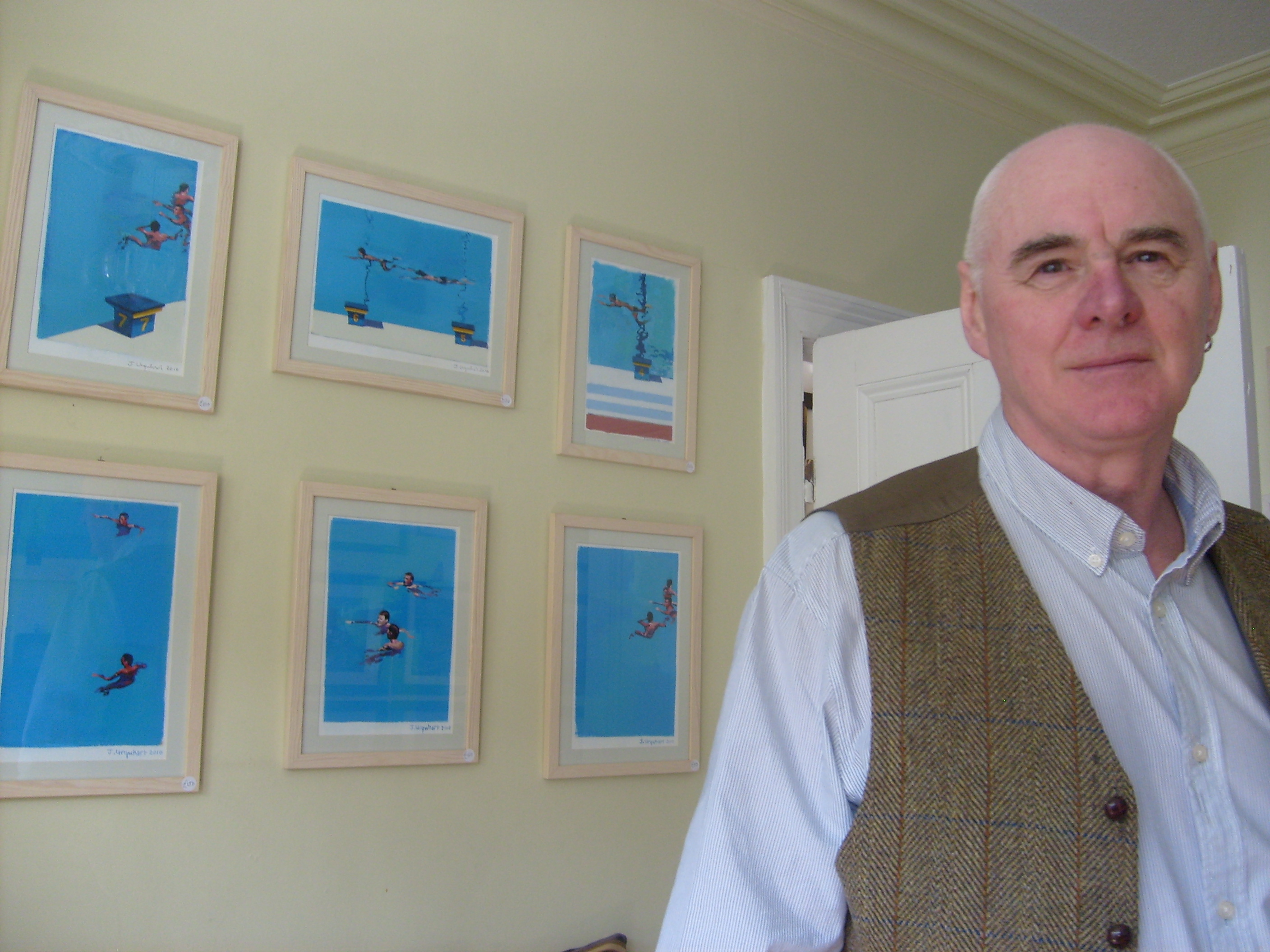
My old friend, Budapest-based Scottish painter JIm Urquhart at an exhibition of his swimming pool painting in Brighton this weekend.

I’ve just spent a few days at the Brighton Festival. I’m here by a sort of mistake – it’s a long story, but by wild coincidence, a good painter friend of mine from Budapest was also in Brighton this weekend – exhibiting his paintings as part of the event (note to self: I must blog about how threads of wild coincidence knit through my life, yet I can never use them in my fiction as they are just too unbelievable).

Jim Urquhart is a Scottish painter who has lived in the Hungarian capital for decades. He was actually one of the first people I met in Hungary in 1998 when I moved there first, and has remained a great friend and artistic supporter down the years. So, I was delighted by the serendipity which had us both wash up on the shores of Sussex this weekend. Great show too, Jim!

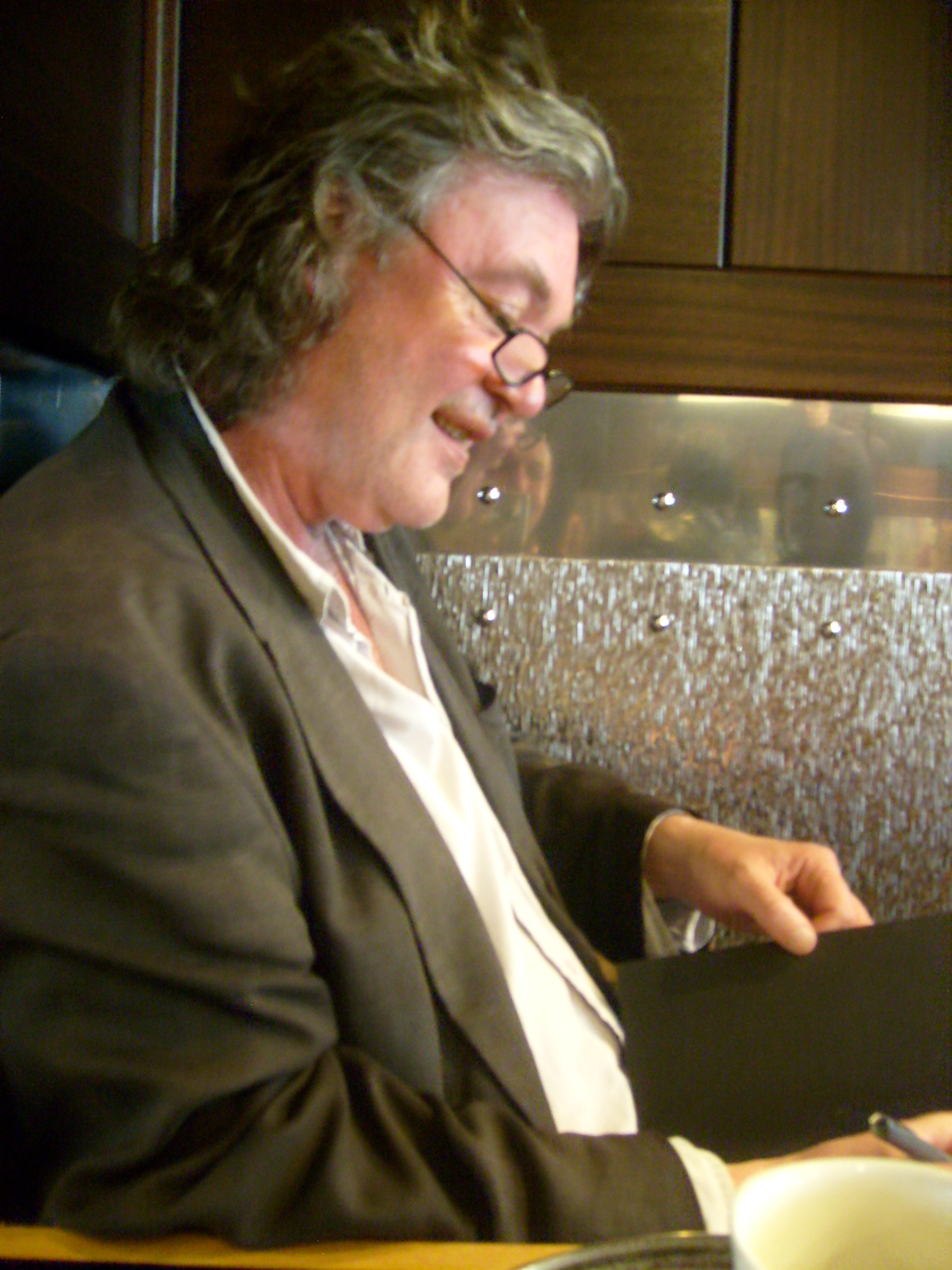
Brighton also allowed me the opportunity to catch up with another friend, the County Antrim poet and current Brighton resident, Brendan Cleary. I get great inspiration and encouragement from artists working in other art forms and meeting up with Jim and Brendan over the weekend, has also delivered all the other positives that time spent with good artists provides: discussion and progression of ideas, affirmation that art is what I am about and what I should do, reassurance that as difficult and isolating it can be to be an artist, it is also hugely rewarding. And, if you are an artist, there is nothing you can really do about it – you have to create.

I’m thanking whatever powers conspired to get me here this weekend to hang out with such creative minds. I’m all fired up and reassured. Here’s to artistic fellowship!

Brighton also allowed me to catch up with another old friend, Brighton-based Co. Antrim poet, Brendan Cleary.


Quite a Character

Name her. Now answer the questions below about her.

If you want to hook your readers, you’ll need a character that leaps off the page. A good character is believable and interesting. Firstly, be careful your character is not of music-hall-cliche stock (dumb blonde, greedy banker, uber-organized German, upper class twit etc…) – the problem here is that the reader will have met your character far too many times before to find them interesting now. As usual, turning the cliche on its head can be a good place to start getting ideas (chess-master page three girl, a banker who secretly gives away money etc…)

Also, don’t focus on describing what they look like from head to toe. In fact, their general physical appearance is not so revealing – the key is often in the interesting quirks and blemishes. Moreover, you ought to climb inside your character’s skin, get to know them intimately and let the reader see how they tick. It  is  good if there is something unusual about them. Here’s a sample list of questions you could mull in order to give your character depth:

Rather than describe the colour of their hair and eyes, write instead about their height.

What about their gait, posture and walk? Does he flutter, jerk, flap or glide?

If you first met this character, what would strike you most?

Does s/he resemble an animal?

What is their natural scent?

What sort of diet do they have and what has been the physical impact of this regime?

What does their best friend think of them?

What happens when your character gets drunk?

What does your character have in his/her pockets/handbag/beside table?

What is your character’s favourite joke?

Also, to make your character particularly memorable, give him/her/it a singular physical attribute your reader will long associate with them. Think of it this way, if you were going to a costume party dressed as Harry Potter, Sherlock Holmes, Miss Havisham or Liesbeth Salander – what would you need? My guesses are, respectively: a lightening bolt scar, a deerhunter hat and pipe, an old wedding dress, and a dragon tattoo. Try to imagine what you’d need to be recognizable as your character.


Hirst Impressions

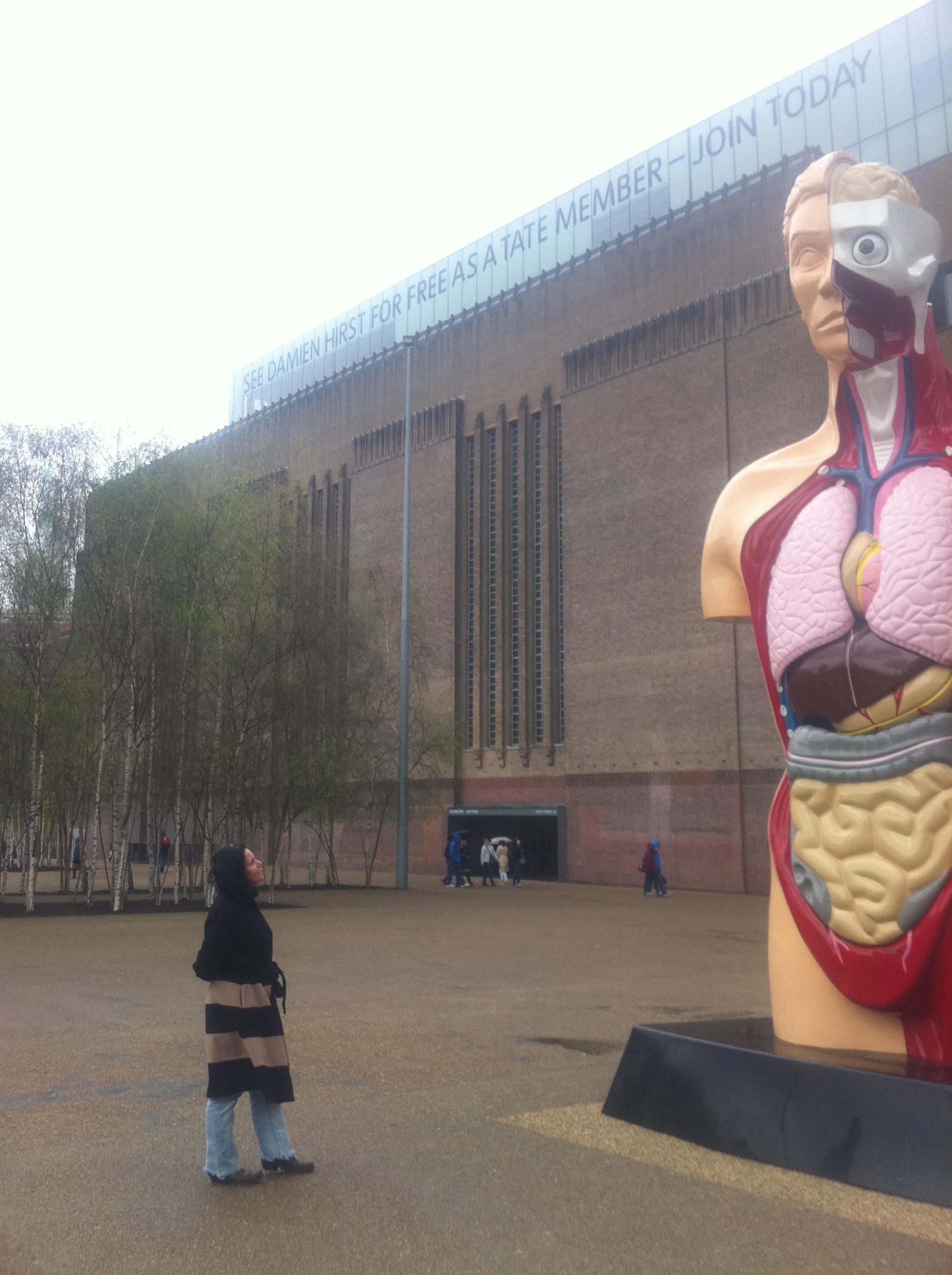
Herself and Himself – me in conversation with Damien Hirst’s work, outside the Tate Modern, Southbank, London, April 2012. – Photo Amelia Nunes


Art begets art. A meeting between like-minded artists often results in a cross pollination of ideas which inspire, progress and crystallise art projects. Such an exchange can be an intended collaboration, or it can be an ego driven ‘anything-you-can-do-I-can-do-better’ brandishing. And it hardly matters which,  so long as art ultimately benefits.

Likewise, great inspiration can be found in complementary art forms. A poet can conjure new ideas from a dance; a musician can be moved to compose by a script. I a primarily a writer of prose fiction but as an Art College alumna – when I’m looking for inspiration, I go to an art gallery.

I went with a housemate on a field trip to London last week to see the Damien Hirst retrospective at the Tate Modern, the Picasso at the Tate Britain and the Freud at the National Portrait Gallery. All three were fruitful visits but, it was Hirst that had me stunned and flushed with ideas.

I’d seen Hirst’s ‘Shark’ before and was struck then by the concept that the creature did not know he was dead. The retrospective examines death in more detail. Death, an inevitable aspect of life, is not morbid in Hirst’s world, however. Rather it is presented as a beautiful  climax (Diamond Skull). Dead butterflies are arranged in stunning giant mosaics reminiscent of great stained glass windows. Even a grand wall-size black circular ‘sun’, composed of a million dead flies has all the elegance and plush luxury of a carpet fit for the feet of kings. Life/death – this complementary nature of opposites runs throughout the artist’s work. The mundane, even ugly are elevated to beautiful objets d’art. A classically sculpted marble angel reveals insides weird and devilish. A dead, fly infested cow’s head celebrates life cycles. Hirst’s work tells us that opposites need each other to exist. Opposites are each other. Rock it, Damien.


I’ve been haiku’d!

A haiku for a weeping willow in Norwich?


If you need focus, get haiku’d. The Japanese know how to appreciate the moment: tea ceremonies where the design and the feel of the cup is lauded, the colour of the drink discussed, the scent, the very feel of the beverage dissected and praised.

Not surprising, therefore, the land of the rising sun gave us the haiku. Haiku is a poetic form that, traditionally, aims to capture a moment in nature, like a snapshot with words.

Most typically achieved using seventeen syllables arranged in three unrhymed lines of five, seven and five syllables, the practice of writing haikus is particularly useful if you are engaged in a word-limited literary arena such as writing songs. In such instances, words should be chosen carefully so that they can convey the specific mood, meaning and impact you require and haikus can help you build up that muscle. Haikus encourage you to pick up every word and study it closely for its sound, meaning, feel and impact.

Here are some examples of the haiku:

O’er the wintry wood,

winds howl in an empty rage

with no leaves to blow.

Soseki (1275-1351)

This haiku by the ‘punk poet, John Cooper Clarke, comes via recommendation of Westown Girl :

Writing a poem

In seventeen syllables

Is very diffic.

(John Cooper Clarke, 1979)

Cool, innit?

Happy Haikuing


You Don’t Have to be Irish…

A picture from Ireland - Lismore Castle, Co Waterford. My grandmother's hometown.

You don’t have to be Irish to be a great writer, but it helps. An oft debated point is the essential ingredient that has given the Irish the edge re the written word ever since the Book of Kells. There are many takes on the matter. Some say it’s because although most Irish writers write in English, they use the syntax, structure and playfulness of the Irish language which gives a mastery and an unusual manner of wielding English that results in, well, pure poetry. Others suggest it is our tradition of story telling, living on in sizzling and stinging pub banter. Some put it down to our sad history, allowing for a depth and pain to infuse our written word. However, I’m with the crowd that says its simply because we’re a race of freaking geniuses. Happy St. Patrick’s Day! Go mbeirimid beo ar an am seo arís…

Famous Irish writers: Sebastian Barry, Samuel Beckett, Elizabeth Bowen, John Banville, Brendan Behan, Dion Boucicault, Roddy Doyle, Emma Donoghue, Maria Edgeworth, Brian Friel, Oliver Goldsmith, Neil Jordan, John B. Keane, Colum McCann, John McGahern, Iris Murdoch, C.S. Lewis, Edna O’Brien, Jennifer Johnston, James Joyce, Patrick Kavanagh, Molly Keane, Hugh Leonard, Martin McDonagh, Frank McGuinness, Sean O’Casey, Joseph O’Connor, George Bernard Shaw, John Millington Synge, Colm Toibin, Oscar Wilde, WB Yates, Bram Stoker, Jonathan Swift… to name but a few.


Naked truth

Self portrai in oil pastel, self-portrait in mirror.


Writing from truth, using a real event, can lend work real emotion, emotion difficult to conjure otherwise. Tears in a writer will bring tears to a reader, so they say. And as an artist, it is often your job to stand naked in front of the world.


Writing from fact does have its downside, however. Firstly, a straight account is reportage, not fiction so you must add extra spice and colour to the mixture to make it fiction, and interesting.


It is important to get to the naked crux of what your story is ‘saying’ and make sure your narrative never loses sight of this point and – so, even if when you were all driving to the hospital, Brad told a joke so funny you’ve just got to mention it. No, don’t mention it. Stick to the point of the story – the story is the hospital, remember, not Brad’s unrelated joke.


You may also have to leave out years of backstory if it does not serve to drive your own story on in any way. You may have been brought up by the funniest, most eccentric, most loving or most dysfunctional family in the world, but if they have no role in the story at hand, don’t mention them.


Another issue with writing from real memory is that ironically, fact is often too weird and too unbelievable to work as fiction. Your readers will say, ‘oh, come on, that would never happen.’ And you can’t phone them all up and say, ‘actually, it did. I’m not making it up. I once knew this bloke…’ Instead, you’ve often got to tone down the story to make it more credible. Real-life coincidences can be particularly problematic here.


And remember if you stick too close to the truth, you may be setting yourself up for some legal headaches, especially if you are presenting another person in an unflattering light. It’s best to change names and/or genders, and settings. Once you make those factual changes, most people will fail to recognize themselves in fiction, simply because we don’t see ourselves as we are seen by others….