
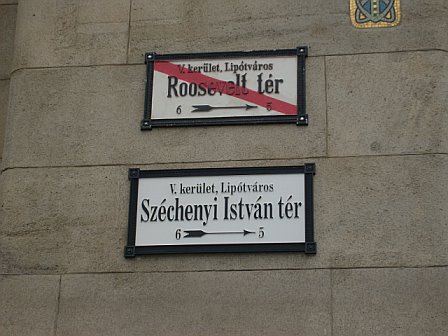
New street name in Budapest.
I’m back in Budapest visiting old friends – and in a much cheerier place. Apologies for the rather depressing last post – and thank you for all your messages and comments. I was a little melodramatic, having a bad moment, when I wrote the previous post… the sun is out again and I’m still super productive, so scratch that ‘depression is the way’ theory…
Being back in Budapest means I notice changes in the city more than perhaps I did when I lived here. The new government are bent on renaming streets which they feel have perhaps ‘too leftist’ monikers. So Moscow Square has been renamed after a right wing economist and even Elvis Presley has now had a street named after him, in a recent re-~Christening sweep. Budapest has form when it comes to renaming street to reflect the political mood. Oktogon has seen past incarnations as ‘Hitler Square’ and later, ‘Lenin Square’.
And this thought leads perhaps somewhat inelegantly to the writers need to re-work or scrap words when re-drafting.
‘Murder’ or ‘Kill your darlings’ is an adage attributed to the literary critic Sir Arthur Quiller-Couch, advising writers to cut the words / phrases to which they are most attached, in order to strengthen the work. It is good advice when editing, as often we writers shoehorn in a delicious description which doesn’t do an enormous amount for the piece as a whole. It is simply a bauble. Time to get the gun out.
Editing makes the job of writer a rather schizophrenic affair where one has to don two very different caps. The first cap is that of the creative free thinker who is focused on the big picture and is not too worried about the details. This is the person who comes up with the story, the theme, the basic structure, the person who invents characters and decides on the tone. This artist-writer will draw up the first draft of the story, writing only to please themselves. Finishing a draft wearing this cap is only some of the journey, however…
Next comes the cap of editor-writer. This is when the writer combs through the text, ruthlessly chopping, restructuring and cutting unnecessary/ unsuitable words, characters, scenes, phrases etc… or ‘murdering your darlings’. This is the writer preparing the text for other people. It is a good idea to leave a few weeks between your artist and editor incarnations.
Editing can be painful, and time-consuming. You’ve quite likely become attached to some characters, scenes, words and phrases and are loathe to see them go. Don’t worry, you can store them in your “writer’s bag” for use at a future time in a more suitable context. In the meantime, get pruning…
Chopping advice:
Cut all surplus adjectives and adverbs.
Examine the phrases you’ve shoehorned in just because you liked the sound of them – do they really fit that scene? Be honest. If not, bin them.
Take out all vague words such as “seem/seemingly” and try to do without your “justs”.
Look at all sentences that run for two or three lines. Do they really need to be that long? Can you reduce them or break them up? If you can, do so.
Active forms are better than passive forms, where possible (ie. “John cleaned the flat” rather than, “the flat was cleaned by John”).
Finally, every writer on Earth needs a reader or two – fresh eyeballs to run over your work and give you honest feedback. I suggest using three friends whom you trust will be frank with you. You don’t have to take everything they say on board. Do consider what they say, however, and if all three come back and say a character is not working. The character is not working. Rewrite.


 suehealy
July 29th, 2012 at 03:07
That changed my perspective on editing … Thanks!
July 29th, 2012 at 12:32
This post couldn’t have come at a more appropriate time. Much needed. Thanks!
July 30th, 2012 at 00:58
Ah, yes, the Evil Editing cap. I learned a long time ago that I am the most long-winded, stuff-it-until-it’s-bursting writer on the planet. Firmly in Hemingway’s “First Draft of Anything is Shit” School. But I’ve helped myself a lot by adopting an order of self-editing before a piece even goes to first readers. I write all my fiction in long-hand, unedited, first. Then it gets the first edit as I type it. Finally, a second, tighter edit when I go back over that typed copy after leaving it alone for few days. Then off to first readers, editors, and so on.
The more eyes on it, the better, imo!
July 30th, 2012 at 13:53
Informative… but I cannot wrap my mind around what is wrong with Roosevelt? He was certainly not a Hitler or Lenin.
July 30th, 2012 at 22:59
I believe it was Hemingway who said that he knew he khad a productive day when he started with three pages in the morning and got it down to one by the afternoon. Glad you’re in a better place.
August 1st, 2012 at 21:11
I have just had my writing edited by another for the first time … and, in the end, what a positive experience, helping me to view my writing much more objectively and make my novel ready for publication. Things cut and clarified have actually made me feel so much better about my novel. This is a great post, Sue.